"Why train?" Because I've always loved train rides. That's it. If you try to find logic in travelling by train, you won't find any. It is neither convenient, nor a time-saver, nor cheap, nor particularly luxurious. So don't look for logic. Either it is for you — or it simply isn't."
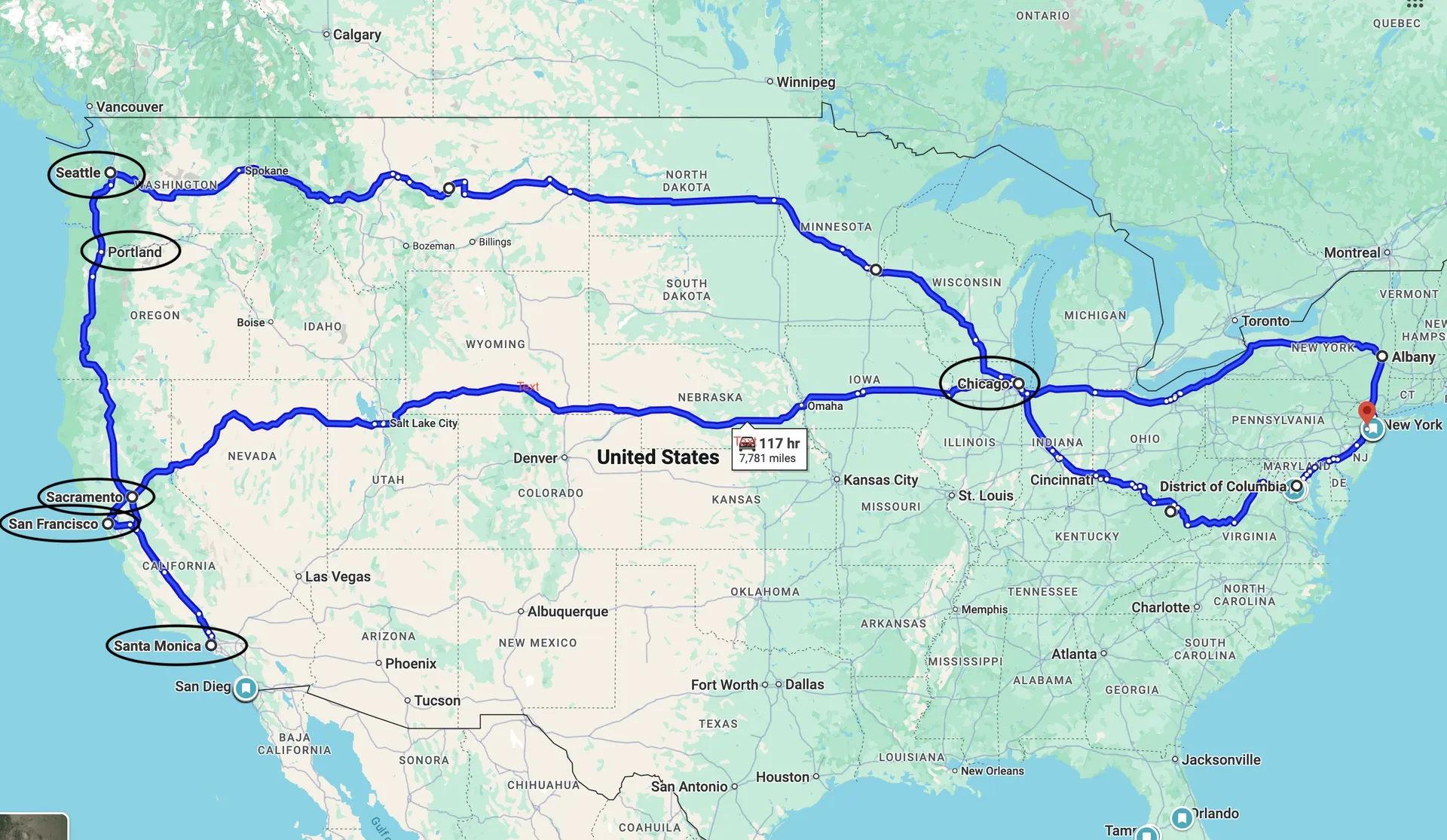
My family was heading to India for the summer. The kids, the wife, the whole production. I had work commitments that meant I'd follow later — which left me with a window, a Amtrak USA Rail Pass, and a very simple question: what's the most interesting way to get from New York to California and back?
I'd moved from India to New Jersey about two years ago, and while we'd covered a fair bit of the East Coast and done a few big Western trips as a family — Grand Canyon, Zion, Bryce Canyon — the vast middle of America had largely passed me by at 35,000 feet. This was my chance to see it at ground level. At train speed. At the pace the country was actually meant to be crossed.
I built the itinerary around three rules: visit cities I hadn't been to yet, take routes I'd never travelled, and never stay more than two nights in any one place. The goal wasn't deep immersion — it was breadth. Skylines, downtowns, iconic landmarks, and then back on the train.
- A fixed-price pass that gives you a set number of travel segments on Amtrak's national network
- Each boarding (not each train) counts as one segment — so a connecting journey via bus may use an extra segment
- Coach class is unreserved on some trains, reserved on long-distance routes
- Dining cars on long-distance trains are for sleeper passengers only — coach travelers use the Café Car
- Wi-Fi exists only on regional trains (Northeast Regional, Capitol Corridor, Cascades) — preload your entertainment
First Night on the Rails
The journey began, somewhat unglamorously, at Metropark station in New Jersey — a NJ Transit hop to Penn Station in New York, where I boarded the Lake Shore Limited for Chicago. I'll admit I wasn't sure what to expect from an Amtrak station. What I found was genuinely impressive: a proper waiting area, clean restrooms, a free luggage service called Redcap, and an arrivals board that felt reassuringly airport-like. Every seat had a charging point. It had a dignity that I hadn't anticipated.
One thing that surprised me: you cannot go to the platform ahead of time. When they announce your train, you queue up and are directed to your coach car — and to a specific seat within it. Even in coach, it isn't a free-for-all scramble. You can move seats later, but only after letting the car attendant know. It's a small thing, but it sets a tone of orderliness you don't always expect from a budget travel option.
As soon as the train pulled out and cleared the tunnel, it began running alongside the Hudson River. I thought it would be a brief, pleasant view. It lasted all the way to Albany.
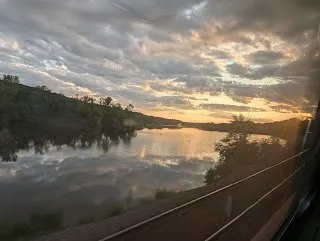
The evening light on the water was something else entirely. The river reflects the sky in a way that makes everything feel slightly cinematic, and I quickly understood why this particular stretch is considered one of the more beautiful rail journeys on the East Coast. The sun dropped slowly, the clouds turned amber and pink, and somewhere north of Poughkeepsie I stopped taking photos and just watched.
I slept reasonably well that first night — better than I'd expected. A neck pillow and a light blanket turned out to be non-negotiable essentials. I noted this carefully, because I'd be sleeping on trains for the next two weeks. One good night was proof enough that it was doable.
In the final hours before Chicago, the landscape gave way to rail heritage — old stations converted into museums, vintage engines and coaches displayed on sidings, quiet monuments to the era when the train was how America moved.
- Duration: ~18.5 hours (overnight, New York to Chicago)
- Car type: Viewliner single-level coaches
- Dining: Café Car for coach passengers (full dining is sleeper-only)
- Wi-Fi: Not available — download podcasts, shows, books before boarding
- Must-pack: neck pillow, blanket or light layer, snacks for the journey
Chicago in Festival Mode
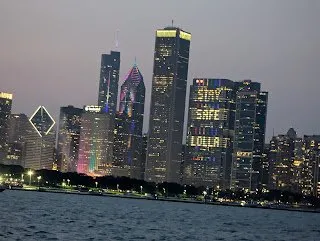
I'd spent a week in Chicago last November, so the city wasn't new to me. What was new was the energy. Lollapalooza — one of the largest music festivals in the world — was in full swing at Grant Park, and the entire city had been transformed by it. The skyline itself seemed to be celebrating: buildings lit up their facades with messages and colours, and the streets near the lakefront buzzed with that particular kind of joy that only large outdoor events generate.

Grant Park itself was closed to the public for the festival, which meant no Buckingham Fountain this time around. A small disappointment, easily absorbed. I did the rounds I'd missed or wanted to repeat — Millennium Park, Navy Pier, the Riverwalk — and had dinner at Maharaj Indian Grill, which, if you find yourself in Chicago and craving a proper Indian meal, I'd genuinely recommend.
Chicago is one of those cities that rewards repeat visits. Each time the vantage point shifts slightly, and you notice different things. This time, with the festival energy and the August heat and the lakefront crowded with people who had absolutely nowhere else they needed to be, it felt more alive than November's version of itself. I left the next morning glad I'd built in the layover.
The California Zephyr: America's Most Scenic Train
If there is one train journey that justifies the entire premise of crossing America by rail, it is this one. The California Zephyr runs from Chicago to the San Francisco Bay Area — nearly 2,400 miles, just under 51 hours — and it passes through some of the most visually extraordinary landscape the continental United States has to offer.
The Sightseer Lounge — where I lived for two days
The Zephyr runs Superliner coaches — double-decker cars with a upper observation level called the Sightseer Lounge. This is the crown jewel of long-distance coach travel. The upper deck has oversized curved windows that angle upward toward the sky, swivel seats designed specifically for watching the landscape, and an atmosphere that quickly becomes social. Families play cards on the tables. Strangers strike up conversations. People who've never met end up spending hours together just watching America go by.

I staked out a window seat early and barely left. This is where I'd spend the majority of the next 49 hours, and I have absolutely no regrets about that decision.
The Corn Belt, the Great Plains, and then — Denver
The first stretch out of Chicago takes you through what's called the Corn Belt — flat, intensely farmed land stretching to every horizon. Illinois, Iowa, Nebraska. It's the agricultural engine of the country, and while it isn't the scenery you came for, there's something quietly meditative about watching it pass. The scale of American farming is genuinely hard to comprehend from a map. From a moving train, you start to feel it.
Denver arrives as a surprise. The city materialises from the flatness like a mirage — and then, as the train heads west from Denver station, everything changes simultaneously and completely.
The moment the Rockies appear, you understand why people made this journey before there were photographs to warn them what was coming. Nothing prepares you for it.
The Colorado River — mile after mile of wonder
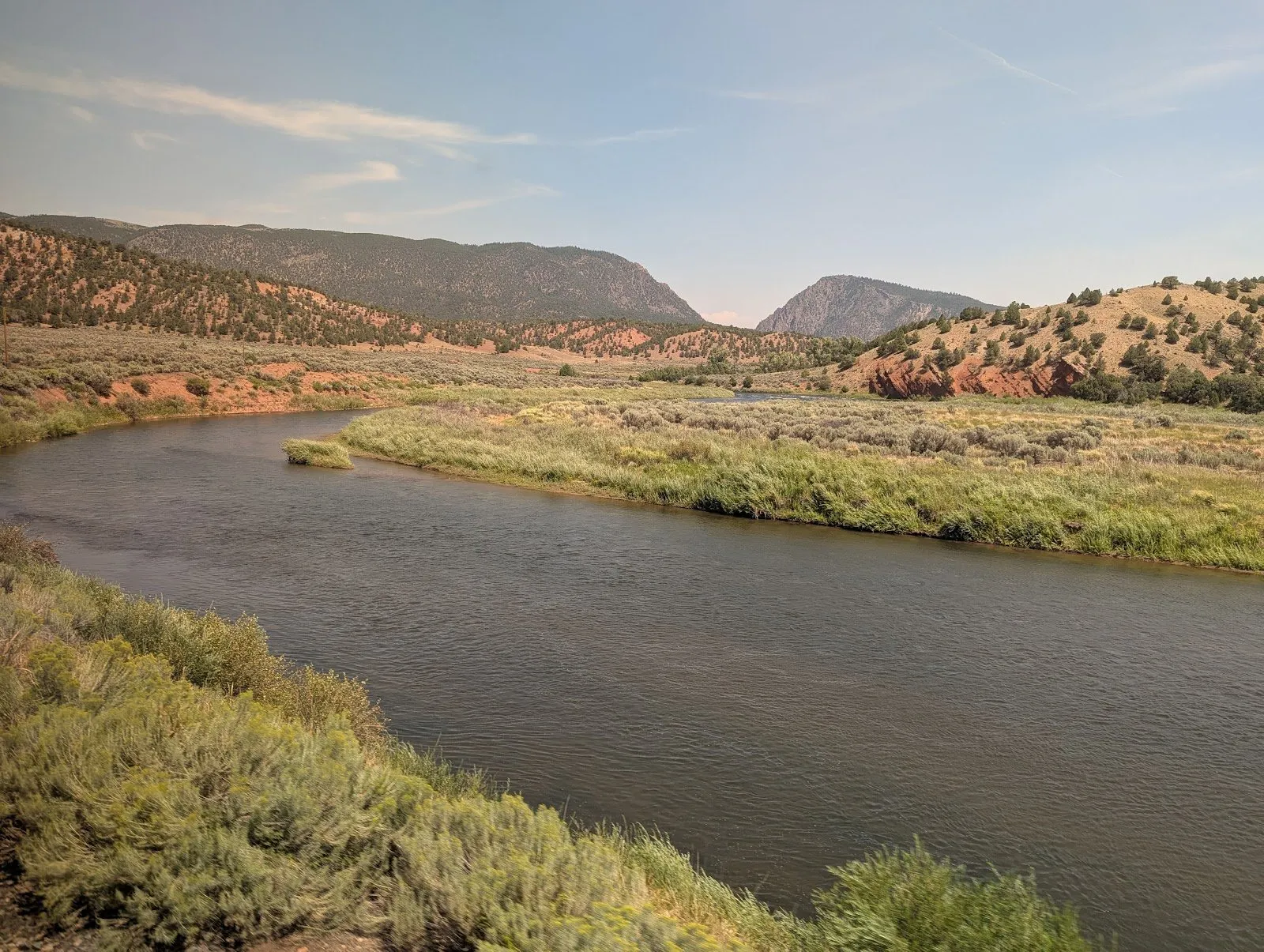
West of Denver, the train follows the Colorado River through the Rocky Mountains, and it does so for hundreds of miles. The tracks hug the canyon walls so closely that at times you feel like the train is being threaded through the landscape rather than running over it. The river rushes below — clear, fast, green — and above, the mountains rise in waves of pine and red rock.
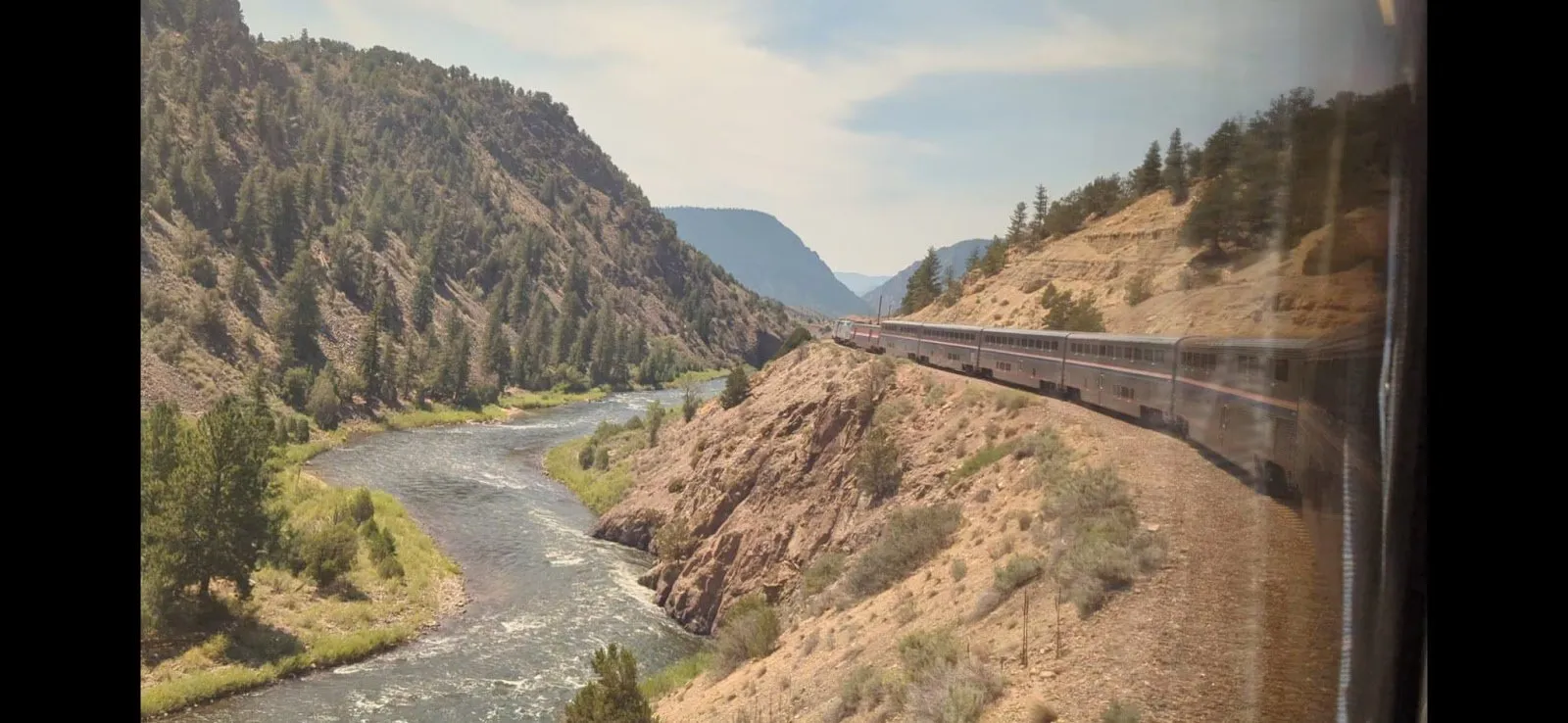
What makes this stretch extraordinary is the activity on the river itself. Groups of kayakers, rafters, and boaters appear constantly, tiny figures against the canyon's scale. You pass camps on the riverbank, people in wetsuits hauling gear up steep paths, children waving from inflatable tubes. It's a reminder that while you're watching the landscape as a spectator, others are living in it.